What to Look for in Tennis and Pickleball Posts: A Guide to Steel, Coatings, and Hardware
When planning a new court or replacing worn-out equipment, the net usually gets the most attention, but the posts holding it up are what determine how well that net performs over time. Posts are under constant tension, exposed to weather year-round, and adjusted repeatedly throughout a season. The materials and construction behind them matter more than most people realize.
Here's a breakdown of the factors that actually affect how long a set of posts will last, using Douglas® posts as a reference point for what higher-spec construction looks like in practice.
Steel Gauge and Wall Thickness
Post durability starts with the steel itself. Steel gauge refers to the thickness of the material: a lower gauge number means thicker steel. Posts on the market range widely, from standard 12-gauge steel (around 0.1046" wall thickness) up to heavier-duty options in the 7-gauge to 11-gauge range (up to 3/16" wall thickness).
Thicker steel resists bending and flexing under repeated tensioning and everyday use. This matters most at high-traffic facilities, e.g. clubs, schools, and public courts, where posts go through frequent adjustment and heavy play.
As an example, Douglas's Premier™ XS Series uses 2-7/8" OD x 8-gauge steel with a 0.165" wall thickness, which is roughly 36% thicker than standard 12-gauge posts.
Tensioning Hardware
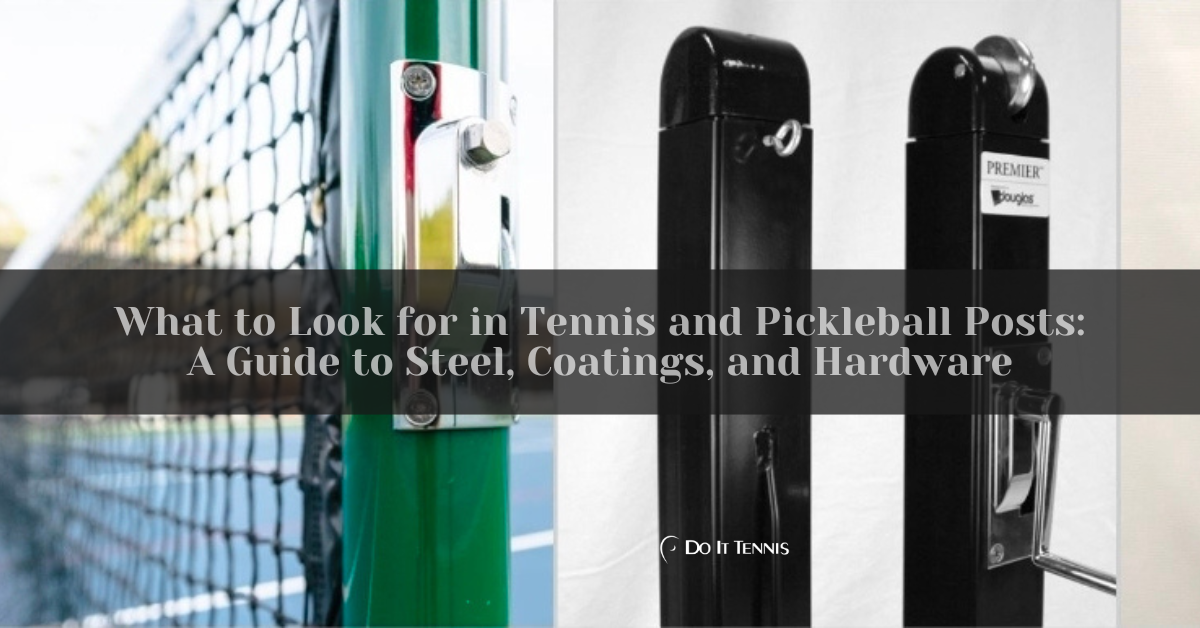
The gear mechanism used to tension the net affects day-to-day usability. Lower-quality hardware can become stiff or difficult to turn over time, which is frustrating during setup and breakdown. Self-locking gear mechanisms with a higher ratio (Douglas posts use a 30:1 ratio, for example) tend to provide smoother, more consistent tensioning with less effort.
Coatings and Corrosion Resistance
Outdoor posts are exposed to sun, rain, and humidity continuously, so the coating matters as much as the steel underneath it.
Two things to look for:
- Coating type. A baked-on polyester powder coat generally holds up better against chipping, fading, and rust than the thinner, matte finishes found on some lower-cost imported posts.
- Interior protection. Standard hot-dip galvanization only coats the exterior of the steel, leaving the interior vulnerable to corrosion over time, often invisible until the post fails. Some manufacturers, including Douglas with its Zinc Flo-Coat® process, treat both the interior and exterior of the steel to address this.
Warranty Length
Warranty length is a reasonable proxy for how confident a manufacturer is in their own materials and construction. Posts on the lower end of the price and quality spectrum often carry a standard 1-year warranty, while heavier-gauge, better-coated posts, like Douglas's lineup, which carries a 5-year limited warranty, tend to come with longer coverage.
Total Cost Over Time
It's worth evaluating posts based on cost per year of expected service life, not just the upfront price. Posts built from thinner steel with weaker coatings are more likely to rust, fade, or bend within the first few seasons, leading to repair costs, court downtime, and earlier replacement. A post that lasts two years versus one that lasts ten can end up costing significantly more over the life of a court, even if the initial price tag was lower.
Round vs. Square Posts
Beyond materials, posts also come in different shapes: classic round posts or more modern square profiles. This is largely an aesthetic choice and doesn't typically affect performance, so it usually comes down to the look a facility wants for its courts.
Bottom Line
When comparing tennis or pickleball posts, steel gauge, coating quality, interior corrosion protection, and warranty length are the specs worth scrutinizing before making a decision, especially for facilities where posts will see heavy, repeated use over many years.
Check our court equipment for more options and information.
Want to stay up to date? Join the conversation:
LinkedIn | Facebook | Instagram | Reddit | Threads.