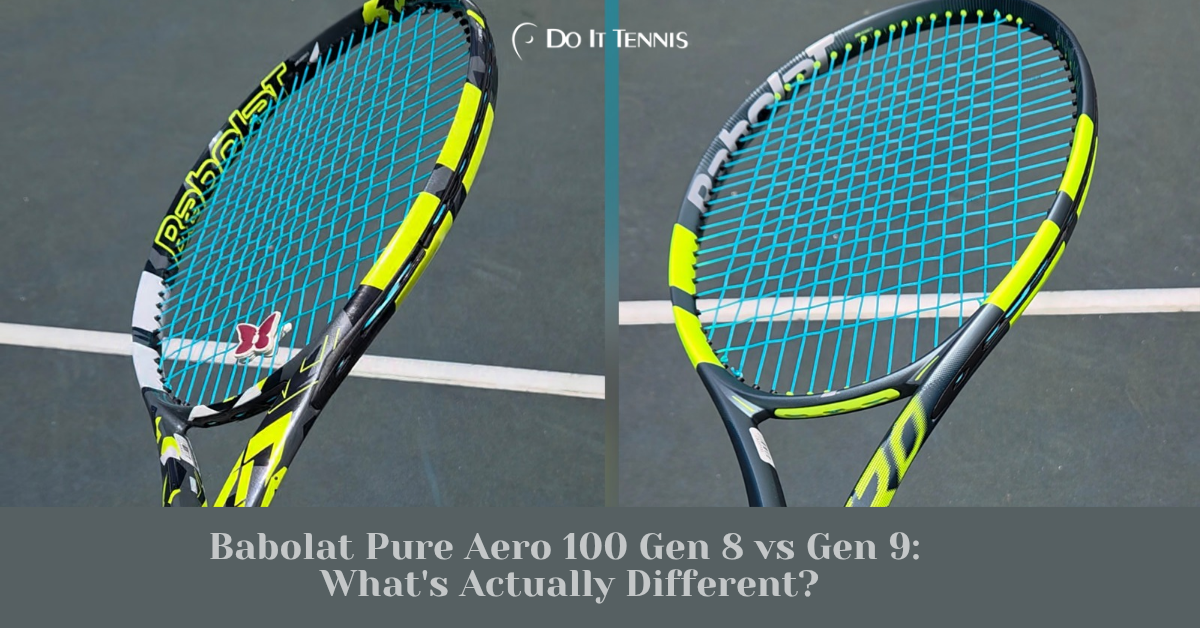
Babolat Pure Aero 100 Gen 8 vs Gen 9: What's Actually Different?
The Pure Aero 100 is the most popular member of Babolat's spin-focused lineup, the larger, more forgiving sibling to the 98, and the racquet most recreational and club players reach for when they want big topspin without needing pinpoint precision. With the 2026 9th Gen update, Babolat made real changes under the hood rather than just a cosmetic refresh. Here's exactly what changed, what stayed the same, and whether it's worth the upgrade.
Quick Comparison: Pure Aero 100, Gen 8 vs Gen 9
| Pure Aero 100 Gen 8 | Pure Aero 100 Gen 9 | |
|---|---|---|
| Head Size | 100 sq. in. | 100 sq. in. |
| String Pattern | 16x19 | 16x19 |
| Unstrung Weight | ~300g | ~300g |
| Stiffness (RA) | ~68 | ~68 (largely unchanged) |
| Dampening Tech | NF² Tech (flax fiber, handle) | NF² Tech 2.0 (unidirectional flax, handle) |
| Aerodynamics | Standard Aeromodular | Aeromodular 4 (redesigned throat) |
| Maneuverability | Solid, but not the fastest-swinging Aero | Slightly quicker feel through the swing |
| Power vs. Control | More raw power, but can feel less controlled on faster balls | Slightly more control-focused, with power still on tap |
| Vibration/Feel | Good, but more noticeable on off-center hits | Noticeably less vibration thanks to unidirectional flax |
| Best For | Players who want maximum spin and easy power | Players who want maximum spin and power, but with more precision and comfort |
What Actually Changed on the 100
The Core Specs Barely Moved — On Purpose
Unlike the 98, which saw a real jump in stiffness for 9th Gen, the Pure Aero 100 kept its head size, weight, balance, string pattern, and RA rating close to the 8th Gen. That's a deliberate choice: the 100 was already designed as the forgiving, easy-power option in the lineup, and Babolat didn't want to change that identity. If you've played with the 8th Gen, the 9th Gen 100 will feel immediately familiar in the hand.

Aeromodular 4: Faster Racquet Speed, Not Just Marketing
The redesigned throat-geometry, developed using CFD analysis and wind-tunnel testing, cuts aerodynamic drag by roughly 6% and translates to about 3% more spin RPM. On the 100, this matters more than it sounds: the whole appeal of this racquet is generating heavy topspin with a compact, easy swing, and reduced drag means you can generate more racquet-head acceleration without changing your swing mechanics.
Refined Dampening, Concentrated in the Handle
Babolat evolved its flax fiber technology to NF² Tech 2.0 for the 9th Gen, switching from a woven pattern to a unidirectional fiber alignment that dampens vibration more efficiently. On the 98, this fiber sits at 3 and 9 o'clock in the hoop. On the 100, it's concentrated in the handle instead, a deliberate difference aimed at general comfort for intermediate players rather than stabilizing the head against torque, which matters less on a more forgiving, larger-head frame.
A Touch More Maneuverable
Several reviewers note the 9th Gen 100 swings with a slightly quicker, more responsive feel than the 8th Gen, likely a product of the aerodynamic throat redesign rather than a dramatic swingweight cut, since the core spec sheet stayed close to identical. It's a subtle change, not a different racquet, but noticeable during extended rallies and fast direction changes at net.

Power, Control, and Feel
Power: The 8th Gen is the more raw-power-oriented of the two. It leans harder on frame flex and generous launch angle to generate free pace, which is great when you want the racquet doing some of the work, but that same extra liveliness can come at the cost of control, especially on faster incoming balls or when redirecting pace, where a livelier frame is more prone to sailing long.
Control: This is the clearest upgrade in the 9th Gen. The more stable, connected shaft construction and refined aerodynamics give it a more predictable, locked-in response, so shots land with more consistency even on firmer swings. Where the 8th Gen sometimes trades control for its extra pop, the 9th Gen dials that back slightly in favor of directional precision. You're still getting plenty of power, just with more of it under your command rather than the frame's.
Feel: This is where 9th Gen shows the clearest improvement. The unidirectional flax dampening filters out noticeably more vibration than the 8th Gen's woven flax setup, especially on off-center hits, and testers who had arm discomfort with the 8th Gen report a smoother, quieter, more comfortable response with the new frame, without giving up the plush, forgiving character the 100 is known for.
Who Should Consider the Pure Aero 100 Gen 9?

If you're an intermediate to advanced player who wants big, easy topspin, a generous sweet-spot, and forgiveness on mishits, the Pure Aero 100 has always been a strong fit and Gen 9 sharpens that identity rather than reinventing it. The improvements are real but incremental: better comfort, a touch more racquet-head speed, and slightly more stable shots, all while keeping the core spec sheet and the price of entry into a more powerful game, essentially unchanged.
If you're currently playing with the 8th Gen 100 and happy with it, this isn't an urgent upgrade. But if comfort, arm fatigue, or control has ever been a concern, or you're coming from an older Pure Aero generation, the 9th Gen 100 is the more refined version of the same racquet you already know.
Join the conversation: LinkedIn | Facebook | Instagram | Reddit | Threads.