US Open Mixed Doubles New Format: Genius Reinvention or Disregard For Doubles Specialists?
For decades, mixed doubles at the US Open was more of a sideshow. Happening on outer courts, tennis fans didn't give the attention it deserved while the singles draws hogged the spotlight. That all changed when the USTA blew up the format, and two years later, the mixed doubles event might be the most polarizing thing happening in the Slams.
What Actually Changed
Starting in 2025, the USTA moved mixed doubles out of the main two-week fortnight and into Fan Week, the week before the singles and doubles championships begin. The matches got shorter too: best of three sets to four games instead of a full six, no ad scoring, tiebreaks at four all, and a 10-point match tiebreak instead of a deciding third set. The whole event wraps in about three days, and the winning team walks away with a cool $1,000,000.
That combination, a compressed schedule plus a massive payday, did exactly what the USTA hoped. It pulled in singles stars who normally skip mixed doubles entirely because it conflicts with their main draw prep. In 2026, the field included Aryna Sabalenka and Novak Djokovic, Serena Williams and Carlos Alcaraz, Jessica Pegula and Taylor Fritz, and married couple Elina Svitolina and Gael Monfils, among plenty of other headline pairings.
The 2026 edition also added a new wrinkle: a qualifying round, giving dedicated doubles specialists a path back into a draw that had briefly shut them out entirely the year before.
The Case For It
There is no denying the eyeball math worked. Watching Grand Slam singles champions team up, sometimes with players they have never shared a court with, injected a genuine sense of novelty into a corner of the tournament that used to be an afterthought. Fans got to see marquee names in a lower pressure, more relaxed format, often producing loose, entertaining tennis and playful chemistry between partners who never play together.
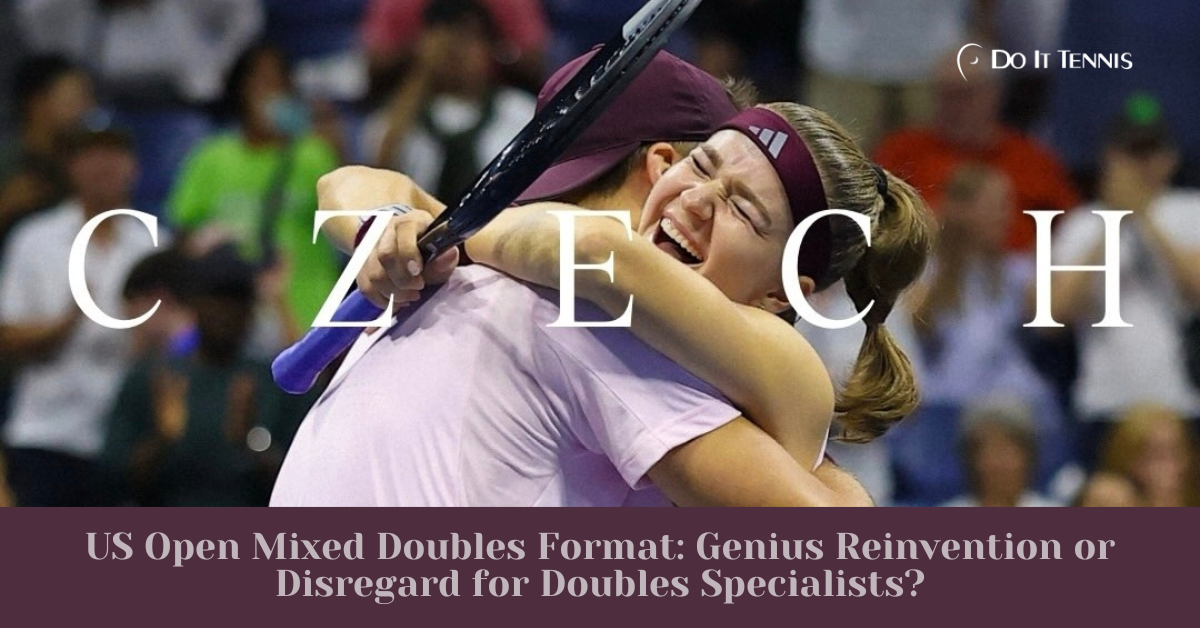
The results back up the appeal too. In 2026, four teams built around singles stars, including Karolina Muchova and Jakub Mensik, and Belinda Bencic and Flavio Cobolli, advanced all the way to the final. Muchova and Mensik went on to win the title in a third set match tiebreak over Bencic and Cobolli, a final that delivered exactly the kind of star power and drama the new format was designed to create.
The Case Against It
Here's where things get uncomfortable. Doubles specialists spend their entire careers building chemistry, developing net play, and mastering a discipline that genuinely differs from singles tennis. When singles rankings became the primary entry criteria, several of those specialists found themselves squeezed out of a major they had every right to compete in.
The frustration is not just theoretical. Sara Errani and Andrea Vavassori, the two-time defending champions and among the very best mixed doubles teams in the world, lost in the first round in 2026 to a pairing of singles standouts who had barely played together. It's a stark illustration of the exact complaint doubles specialists have been raising: rankings built on a completely different skill set are now deciding who gets a shot at $1,000,000 in prize money and a Grand Slam title in an event doubles players spent years earning their place in.
Add in the reality that many of these celebrity pairings had little to no history playing together, and critics argue the event has drifted from being a genuine doubles competition into something closer to an exhibition with a very large check attached.
So Who's Right?
Probably both sides, honestly. The new format has objectively made mixed doubles a must-watch in a way it never was before, and the 2026 qualifying round shows the USTA is at least listening to the specialists' complaints. Whether that's enough to fully address the concerns, or whether the event needs to go further to protect a spot for the players who do this for a living, is a conversation that is far from over.
What's clear is that mixed doubles at the US Open is no longer background noise. It is officially part of the main event, for better or worse, and that alone is a massive shift for a discipline that used to get little attention.
Final Thoughts
Whichever side of the debate you land on, one thing is true: tennis fans have more reason than ever to tune into mixed doubles. Whether you loved watching Serena Williams and Carlos Alcaraz share a court, or you think the doubles specialists deserved better, the format has sparked exactly the kind of conversation that keeps the sport interesting.
Gearing up to watch the next Grand Slam draw? Check out doittennis.com for the racquets, strings, and gear the pros on both sides of this debate are using on court.
Join the conversation: LinkedIn | Facebook | Instagram | Reddit | Threads.