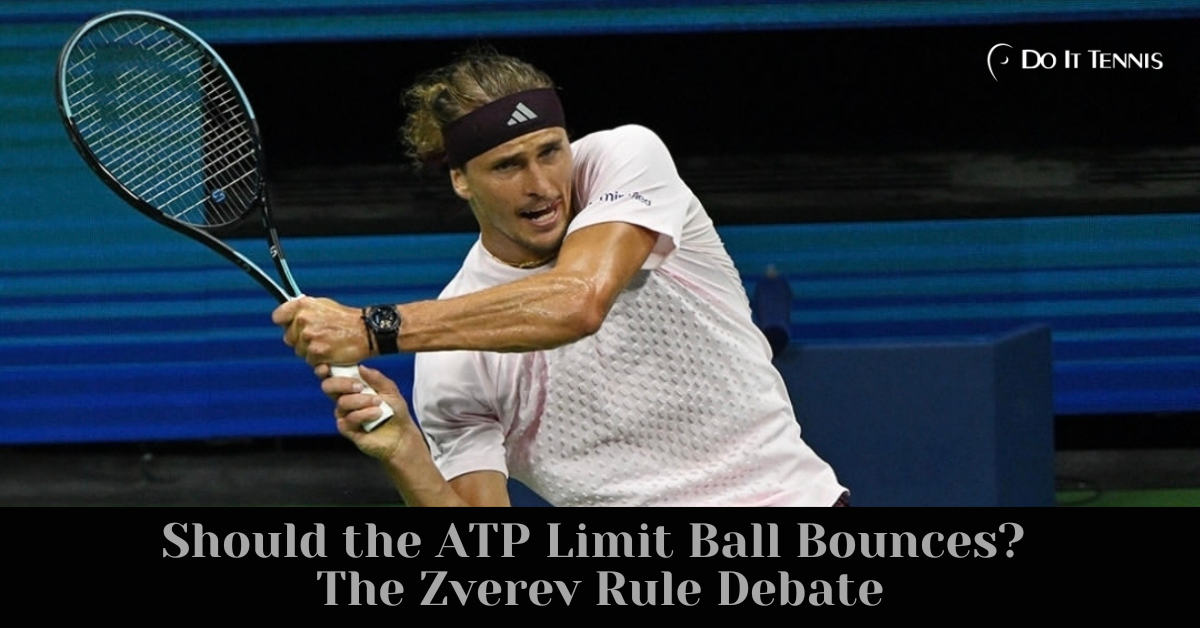
Should the ATP Limit Ball Bounces Before the Serve? The Zverev Rule Debate

Alexander Zverev just won his second Grand Slam title, and yet most of the conversation afterward was not about the trophy. It was about how many times he bounces the ball before each serve.
Anywhere from 20 to 25 bounces, depending on the point, according to opponents and commentators who counted throughout the tournament. It annoys the players across the net from him, it tests the patience of fans watching at home, and it has become one of the bigger storylines of the 2026 US Open. Here is the twist though: it is completely within his allotted time before points. Zverev is not breaking any rule. He is just exposing a gap in one.
What happened at the US Open final
The complaints actually started before the final. After losing to Zverev in the semifinal, Karen Khachanov told reporters that the ball bouncing bothers a lot of players, not just him, and that it takes so much time and makes it hard to know how to prepare for the serve. He said opponents end up resetting into a split step over and over, only for Zverev to keep bouncing, before finally having to reset again. In his view, the routine does not just annoy the person across the net, it actively interferes with their timing and rhythm on return.

Then came the final. Zverev beat Ben Shelton 6-3, 7-6(2), 5-7, 6-2 to claim the title, but the bigger story coming out of that match was not the scoreline. It was Shelton, fresh off the toughest loss of his career, standing at the podium and calling a tennis rule "stupid."
During the fourth set, Zverev did pick up a time violation for going over the 25 second limit players get before a first serve. That part of the rulebook is clear and it worked exactly as designed.
The messier part is what came before it. Chair umpire Marijana Veljovic told Shelton he needed to get into his ready position earlier while Zverev worked through his bouncing routine. Shelton pushed back hard on that in his press conference, and honestly, it is easy to see his point. There is no shot clock for a second serve. So a returner can be told to stand locked in and ready with zero idea whether the next ball is coming in five seconds or thirty.
"I should not have to sit at the line if he is bouncing the ball 20 to 25 times," Shelton said. "I think that is a stupid rule that you have got to be sitting there if it is a guy who has his routine. As long as you are ready when he puts his hands together and stops bouncing the ball, that is what should matter."
Roddick also weighed in on his Served podcast ahead of the final, adding his voice to the growing list of people who think this is something the ATP needs to actually look at instead of shrugging off.
Is Zverev breaking any rules by bouncing the ball this much?
No. That is the part that keeps fueling the debate. Zverev's routine falls inside the current shot clock rules, which only govern the time between points, not the number of bounces within that time. As long as he serves before the 25 second buzzer, nothing about what he is doing is against the rulebook.
Why this is not just Zverev being difficult
To be fair to Zverev, nobody is accusing him of doing this on purpose to mess with anyone. Well, some may, but it's hard to prove it. However, it genuinely looks like a nervous habit or a rhythm thing, similar to how some players can't touch the lines between points or bounce the ball a set number of times out of pure ritual. Plenty of players have quirks at the line.
The issue is not really about Zverev's character. It is about the gap in the rulebook. Tennis has a shot clock for a reason: it protects the pace of the match and gives both players a shared, predictable rhythm. But that clock only covers the first serve. The second serve, where a lot of this bouncing seems to happen, has no such limit at all. So a player can technically stay well within the rules and still make his opponent stand there far longer than the shot clock was ever designed to allow.
The case for a rule change
If you are on Team Change It, the argument is pretty simple. Tennis already accepts that predictable timing matters enough to enforce a countdown clock for one part of the point. Extending some kind of limit, even a longer one, to the second serve would close a loophole rather than punishing anyone for a routine. It would also make the sport easier to watch. A live crowd, and especially a television audience, does not love long dead air between points.
The case for leaving it alone
On the other side, there is a real worry about overregulating athletes' personal routines. Tennis already tells players how fast they must serve. Do we also need to tell them exactly how many times they are allowed to bounce a ball first? Some fans see this as part of the theater of a big match, a habit that becomes part of a player's identity the same way a signature grunt or a between point walk does. There is also a practical question. How would you even enforce a bounce count without making umpires count bounces out loud during a Grand Slam final?
Where we land
We think there is a reasonable middle ground here, and it does not require anyone to ban bouncing altogether. A simple second serve time limit, even something generous like 20 seconds, would solve the actual problem people are complaining about without policing anyone's individual habits. Players could still bounce the ball as many times as they want. They would just need to do it within a window their opponent can count on.
Zverev is not doing anything against the rules right now, and he should not be treated like a villain here. But Shelton and Khachanov are both pointing at a real structural issue, not just sour grapes after a loss. Grand Slam finals are the biggest stage in the sport. It might be time for the ATP to close this gap before it becomes a bigger storyline than the tennis itself.
What do you think? Should there be a shot clock on the second serve, a ball bounce limit, or is this just part of the game? Let us know in the comments or tag us on social with your take.
Quick FAQ
How many times does Zverev bounce the ball before serving? Anywhere from 20 to 25 bounces, based on counts from opponents and viewers during the 2026 US Open.
Is there a shot clock for the second serve in tennis? No. The ATP shot clock currently applies to the time before a first serve. There is no separate limit for the second serve.
Did Zverev get penalized for his ball bouncing routine? He received a time violation in the fourth set of the US Open final for going over the 25 second limit before a first serve, not specifically for the number of bounces.
Join the conversation: LinkedIn | Facebook | Instagram | Reddit | Threads.